Former president of Honduras and U.S. ally, Juan Orlando Hernández, extradited
The 53-year-old former head of state, whose term as president from 2014 to 2022 was plagued by corruption allegations, could spend the rest of his life in prison if convicted of allegedly aiding a conspiracy to smuggle 500 tons of cocaine to the United States.
April 21, 2022 04:50 PM
May 05, 2022 09:17 AM
Former Honduran President Juan Orlando Hernández was extradited to the United States on Thursday to face drug trafficking charges, ending a 66-day legal process that began days after the former White House ally left office in January.
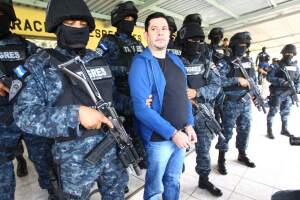
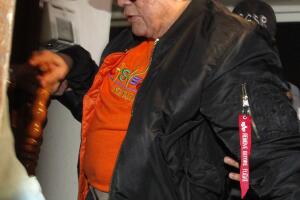
Dressed in a blue jacket, wearing a mask and handcuffed, he was transferred by helicopter shortly before noon to a military base at Toncontin International Airport in Tegucigalpa. He was later escorted aboard a U.S. Drug Enforcement Administration (DEA) plane to fly to South Florida and then to New York. The handover was broadcast live on Honduran television.
Before leaving Honduras, his wife released a parting video in which Hernández insisted: "I am innocent. I have been and am being unfairly prosected".
Once the plane took off, spectators near the airport waved Honduran flags and celebratory fireworks could be heard around the capital.
Getty Images/Getty Images
"El caso de Hernández ha enardecido a sus opositores y a sus partidarios. El resultado es un retrato vívido de dos Honduras muy diferentes bajo su mando".
Shortly after the plane took off prosecutors in New York unveiled the indictment of Hernández which had remained sealed. "The indictment alleges that Hernandez "abused his position as the president of Honduras to operate the country as a narco- state, in order to enrich himself and corruptly gain and maintain power." As a result Honduras became "one of the largest transshipment points in the world for United States bound cocaine," it adds.
Hernández was "a central figure in one of the largest and most violent cocaine-trafficking conspiracies in the world," added DEA Administrator Anne Milgram. "This case should send a message—to all political leaders around the world that trade on positions of influence to further transnational organized crime—that the DEA will stop at nothing to investigate these cases," she added.
ORLANDO SIERRA/AFP via Getty Images
El expresidente de Honduras Juan Orlando Hernandez.
A stunning fall from grace
The extradition is a stunning reversal of fortune for the former president once deemed all powerful, and is almost without precedent in the annals of American justice.
“I can’t believe they pulled it off,” said Richard Gregorie, the former federal prosecutor who indicted Panamanian dictator Manuel Antonio Noriega on drug trafficking charges in the 1980s. “It’s a major coup,” he added.
No other former head of state has been extradited to the United States since Noriega, who was arrested in January 1990 after the United States invaded Panama with almost 30,000 troops. Noriega was once considered an ally of the DEA, like Hernández, but was later convicted of drug trafficking in 1992 and died in jail in 2017.
Hernández was also an important ally of the White House and the DEA for most of his eight years in office, except near the end of his second term. (While he was Panama's ruler, Noriega was not legally considered to have head of state immunity).
Only two other leaders of a foreign country have been indicted in the United States, Norman Saunders of the tiny Turks and Caicos islands in 1985 for a drug trafficking conspiracy and President Ferdinand Marcos of the Philippines in 1988 for massive money laundering. But both were already in the country when they were arrested. Saunders was convicted and sentenced to eight years in jail. Marcos died before he could be put on trial.
The last former head of state to be indicted in the U.S. was Venezuela's Nicolás Maduro in 2019 on drugs and terrorism charges, following elections whose legitimacy the US - and many other countries - do not recognize.
Hernández charged with "state-sponsored drug trafficking"
Hernández's extradition request is an extraordinary conclusion to an in-depth DEA investigation into drug trafficking in the Central American country, which prosecutors have described as "state-sponsored drug trafficking."
The extradition was made in relation to three counts of drug trafficking and use of weapons, including machine guns, according to a copy obtained by Univision.
"The Hernández indictment is actually bigger than the one against Panama’s Noriega given the massive corruption and widespread trafficking of drugs," said Mike Vigil, former head of operation for the DEA.
"Former President Hernández was the dominant force for converting Honduras into a virtual narco state by creating massive corruption at all levels of government," he added.
The former president, has vehemently denied all allegations against him, calling them lies concocted by violent criminals seeking to reduce their sentences.
From humble roots to president of Honduras: Juan Orlando Hernández - in photos
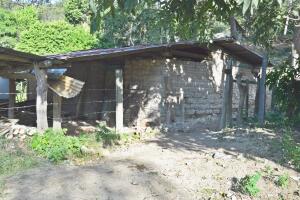
dsc-4427b.jpg
The birthplace of President Juan Orlando Hernández, in Gracias, Lempira, a poor, mountainous province in western Honduras. Photo by Jeff Ernst.
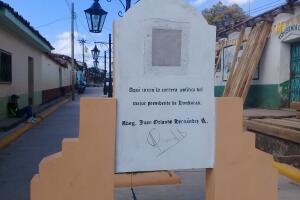
20180111-125055.jpg
A cement plaque sits along a road that’s under construction in Valladolid, Lempira, the home province of President Juan Orlando Hernández: “Here began the political career of Honduras’ best president,” signed by Hernández himself. Photo by Jeff Ernst
colancho2-1.jpg
Honduran President Juan Orlando Hernández grew up in rural Lempira province, one of 17 children of a coffee farmer. Photo courtesy of JuanOrlando.com
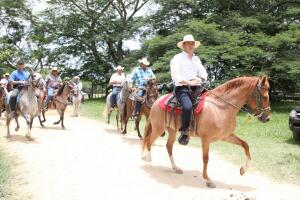
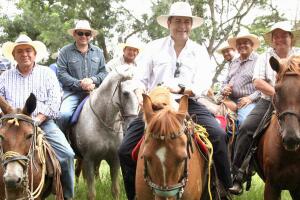
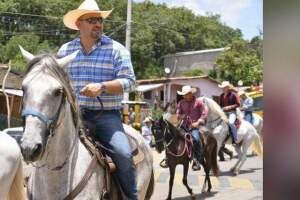
President Juan Orlando Hernández campaigning on horseback. Photo courtesy of JuanOrlando.com
da5.jpg
Honduran president Juan Orlando Hernández campaigned on horseback in rural areas. The president seen here in Olancho (white shirt on the lead horse).
dsc-4436b.jpg
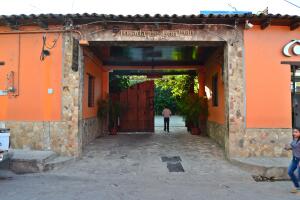
The hotel Posada Don Juan in Gracias, Lempira, is owned by the Hernández family. Photo by Jeff Ernst.
dsc-4438b.jpg
The hotel Posada Don Juan in the town of Gracias, in the mountainous western province of Lempira, is owned by the Hernández family. Photo by Jeff Ernst
dsc-4425.JPG
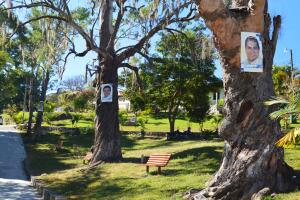
Ruling party election publicity in of La Campa, Lempira, the home province of President Juan Orlando Hernández. The federal government has invested heavily in social programs in rural areas. As a result the ruling National Party won by a landslide in those areas in the controversial Nov. 26 elections. Photo by Jeff Ernst.
dsc-4423.JPG
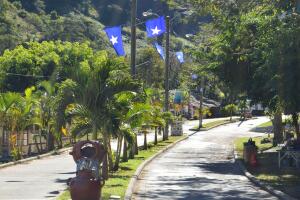
Ruling National party flags adorn the streets of of La Campa, Lempira, in the mountainous western province of Lempira, Honduras, home to President Juan Orlando Hernández. Photo by Jeff Ernst.
dsc-4527.JPG
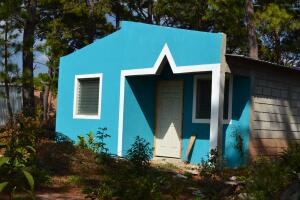
A home built with funds from the Honduran government program Vida Mejor. When Hernández assumed the presidency in 2014, rural families became the focus and the program was placed under the umbrella of Vida Mejor along with a vast expansion of direct assistance programs. Photo by Jeff Ernst
dsc-4523.JPG
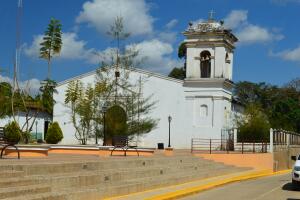
President Hernández’s signature poverty eradication initiative, Vida Mejor (Better Life) is very evident in Valladolid in the westerrn province of Lempira, including this church. Photo by Jeff Ernst.
5a0deb01-02de-4c93-a9b1-aa61b8b9bd54.JPG
President Hernández lay foundation stones at a park, part of a government experiment to create safe places in gang-invested neighborhoods for families to take children to play. Courtesy of the President's office.
Juan Orlando Hernández
Juan Orlando Hernández, president of Honduras during an interview with Univision News at his home in the capital, Tegucigalpa, Jan 19, 2018.
Univision
800-8.jpeg
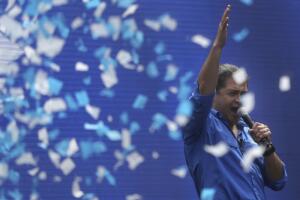
Honduran President Juan Orlando Hernandez speaks during his closing campaign rally, in Tegucigalpa, Honduras. Nov. 19, 2017 file photo, AP Photo/Rodrigo Abd
Juan Orlando Hernandez swearing in
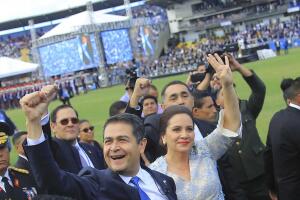
Juan Orlando Hernández was sworn in as president on Saturday for a second term. Seen here with First Lady Ana García at the National ceremony in Tegucigalpa.
Gustavo Amador / EFE
The obstacles to indicting a foreign leader
Not surprisingly, indicting the leader of a foreign country is a major legal challenge, partly due to the immunity they enjoy in office, but also due to issues of the limitations of the reach of U.S. legal jurisdiction outside the United States.
In the case of Noriega and Hernández, the United States argues that the drugs – and money - were being moved through the United States, creating a criminal nexus in this country.
U.S. efforts to indict other political leaders on drug conspiracy charges, such as President Ernesto Samper of Colombia in the mid-1990s, failed because investigators were unable to find a criminal link to the United States.
Gregorie says he ran into stiff opposition from the government of George H Bush, when he told his superior he had enough evidence to indict Noriega, a former CIA asset. “You can’t imagine how many people were mad at me. Many people did not want it to happen,” said Gregorie, who filed the indictment anyway. “That was the end of my career practically,” he said.
Subsequently, the Justice Department established a procedure that all cases involving foreign politicians have to be cleared by the office of the Attorney General.
Gregorie was pushed out of the Justice Department but made a return later as head of the narcotics section in Miami, before he retired in 2018. In the process, he learned a lesson he passes on to young prosecutors.
“When you shoot a king, you better have a big bullet,” he said.
"The closer you get to the sun the more you get burned”
The Hernandez indictment, which has not been made public yet, had been widely expected after he was named as a co-conspirator in three cases in New York, one of which involved his younger brother, former congressman Juan Antonio ‘Tony’ Hernández, who was convicted of drug trafficking and related weapons charges and is now serving a life sentence in prison.
In photos: Tony Hernandez and the drug war in Honduras
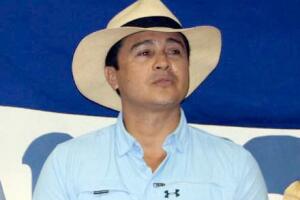
Tony La Prensa
Tony Hernandez in an archive photo.
Courtesy of La Prensa
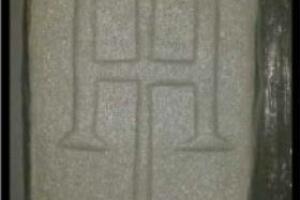
Tony's cocaine (Eng).JPG
Some of the evidence against Hernandez includes weapons and cocaine stamped with his initials, 'TH.'
Court records.
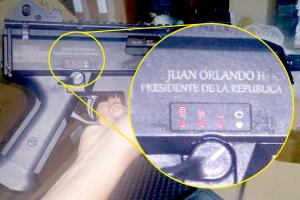
Tony's Scorpion gun
Trial exhibit #203-R4 in Tony Hernandez drug trafficking case in New York: a weapon allegedly carried by the president's brother, embossed with Honduran flag and name of his brother, president Juan Orlando Hernandez, according to prosecutors. “This picture from the defendant’s phone is the embodiment of state-sponsored drug trafficking," said U.S. Assistant Attorney, Emil Bove.
Southern Distirct of New York/David Maris/Univision
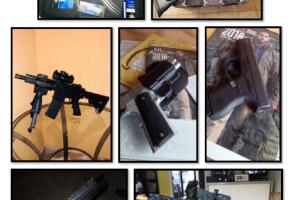
Tony's guns (Eng)
Some of the evidence against Hernandez includes these weapons and cocaine stamped with his initials, 'TH.'
Court records
Honduras drug laboratory (Eng)
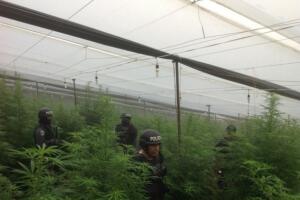
On January 31, 2014, a drug laboratory was raided in the small mountainous village of Iguala in the western province of Lempira. A special police investigation unit arrested two Colombians, seized several weapons and 6,000 marijuana and heroin plants. Two months later, Colombians were released.
Courtesy of the Honduran National Police.
OsorioIMG_2544.JPG
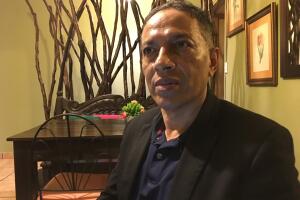
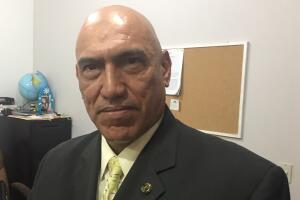
General Leandro Osorio, 55, was head of the special investigations unit of the Honduran police (DNIC) from 2012-2015.
David Adams / Univision
Tony Hernandez (Eng)
Juan Antonio 'Tony' Hernandez (Archive photo)
AP
US Honduran plan 2013
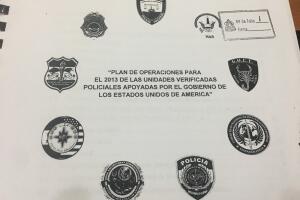
In 2012, the United States and Honduras created special units to combat kidnapping and extortion, as well as a Special Tactical Operations Group (GOET) backed by the FBI with sophisticated eavesdropping technology to listen to phone calls. They prepared an action plan, entitled: "Operational Plan for 2013 of verified police units supported by the government of the United States of America."
Univision
Gen Bonilla (Eng)
The former head of the Honduran National Police, General Juan Carlos Bonilla, during an interview with Univision in 2019.
David Adams / Univision
DEA memo (Eng)
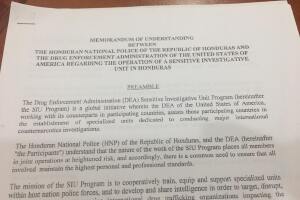
On October 8, 2012, the United States and Honduras signed a secret agreement to create 'Sensitive Investigative Unit" program', or SIU in Honduras. The program allows the DEA to vet and train local police and military personnel for use in operations focused on drug traffickers and cartels.
Univision
Clandestine airstrip in Mosquitia, Honduras
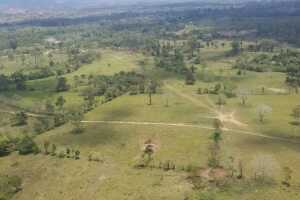
A clandestine airstrip used by drug traffickers in the department of Gracias a Dios, in eastern Honduras.
FUSINA (National Interagency Security Force)
Tony's helicopter.PNG
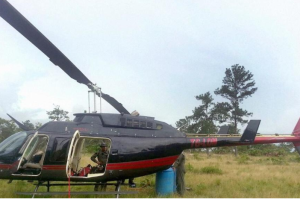
An alleged drug trafficking helicopter seized in the Mosquitia region of Honduras in 2014.
Univision Investiga
Santos Honduras
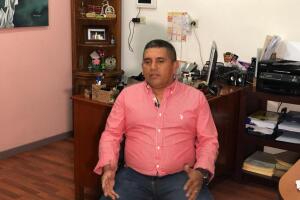
Former Honduran army captain, Santos Rodríguez Orellana, participated in the anti-drug missions. He was suspended from the armed forces and then disgracedly discharged after being involved in the 2014 seizure of a helicopter linked to Tony Hernandez.
Marvin Valladares/Univision
Explosion at clandestine airstrip in Honduras
One of four explosions during a Honduran military operation to disable a clandestine airstrip in eastern Honduras, creating craters 10 meters wide and 5 meters deep. May 15, 2019.
FUSINA (National Interagency Security Force)
Destroyed clandestine airstrip in Honduras
The Honduran Armed Forces disabled a clandestine airstrip with explosives on May 15, 2019, in the Brus Laguna region of Gracias a Dios, eastern Honduras. But officials told Univision the runways were often quickly repaired in a matter of days by teams of men armed with chainsaws and baskets of dirt to fill in the craters. Honduran officers said they were offered $150,000 to look the other way.
A clandestine airstrip in the department of Gracias a Dios, in eastern Honduras.
FUSINA (National Inter Agency Security Force)
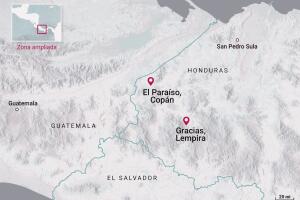
PHOTOS/Map of Honduras.jpg
Western Honduras is a remote border area with Guatemala and El Salvador.
Mauricio Rodriguez-Pons/Univision
Ardon.jpg
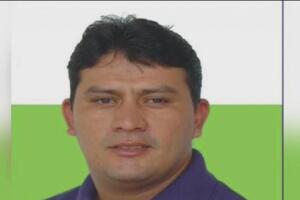
Alexander Ardon, the former Honduran mayor of El Paraíso, a cattle town in the department of Copan, will be a key witness in the case of drug trafficking against President Hernández's brother.
Lopez Sanabria (Eng)
Nery Orlando Lopez Sanabria was captured in June 2018 in Honduras with drug ledgers that implicated Tony Hernandez. At the time of his arrest, Lopez was believed to be one of the largest drug traffickers in Honduras. He was murdered in a maximum security prison in Honduras, October 26, 2019.
Courtesy of La Prensa.
Tony H DEA interview.
After his arrest at Miami airport in November 20188, Tony Hernandez sat down for an "interview" with DEA agent Sandalio Gonzalez. He made a number of self-incriminating statement about his relationship with several notorious drug traffickers that were used against him at trial.
Southern District of New York/Univision
Mauricio Hernandez Pineda.jpg
Mauricio Pineda Hernandez, is a former deputy-commissioner of the Honduran National Police who was stationed in western Honduras.
Southern District of New York evidence files.
Devis Leonel Maradiaga Rivera (ENG)
Devis Leonel Maradiaga Rivera, a former leader of the infamous 'Los Cachiros' crime family who began cooperating with the DEA in 2013 and has confessed to conspiring to kill at least 78 people.
Univision
Don H.jpg
Hector Emilio Fernandez, alias 'Don H,' was arrested in Honduras in October 2014, and extradited to the United States in September 2015. He plead guilty to trafficking 135 tons of cocaine and large quantities of methamphetamine over the course of 17 years and was sentenced to life in prison in August. Tony Hernandez admitted to the DEA that he had mert eith Don H, although he did not disclose why. Don H admitted to paying millions of dollars in bribes to Honduran officials, including former president Mel Zelaya.
Courtesy of La Prensa.
El Rojo - El Periodico.jpg
Victor Hugo Diaz Morales, alias El Rojo, confessed to trafficking at least 150 tons of cocaine with Tony Hernandez and conspiring to murder at least 18 people. Hernandez admitted during a post-arrest interview with the DEA to having had a “good friendship” with Diaz Morales, having received gifts from him as well as knowing that he was a drug trafficker.
Courtesy of El Periodico, Guatemala.
Cubeta (Eng) Mario Jose Calix.jpeg
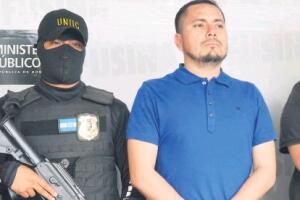
Mario Jose Calix, alias 'Cubeta' (Bucket), was born and raised in 'Tony' Hernandez's home town of Gracias, Lempira where he was vice-mayor from 2010 to 2014. His family owns an attractive local hotel, Finca del Capitan (The Captain's Farm). According to a DEA interview with Tony Hernandez, it was an open secret that Calix was a drug trafficker. He was indicted of drug trafficking charges by the Southern District of New York on January 23 2019, and is a co-defendant in the Hernandez case.
Univision
Finca el Capitan, Gracias, Lempira
In his DEA interview, Tony Hernandez described attending meetings at Finca del Capitán, a hotel in Gracias owned by the family of accused drug trafficker Mario Jose Calix, alias 'Cubeta.' "We'd drink. They would bring in girls. Jeez, they have never been short in the girls department," he said. "As a matter of fact, some girl friends of mine went there, and ... hell! I felt terrible they were going to be passed around all of them. But, it was their lives ... one couldn’t say anything."
Marvin Valladares/Univision
Gracias coffee3.jpg
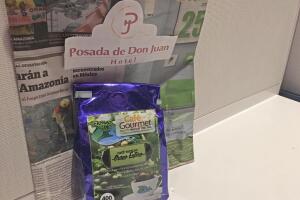
The Hernandez family run an attractive hotel in Gracias, 'La Posada de Don Juan', where they sell their own his altitude coffee named after a local hot spring, 'Termas del Rio'.
The fact that Hernandez did not attempt to escape in order to avoid his capture at some point before his arrest took many by surprise. The drug trafficking conspiracy charges coupled with a weapons charge means he faces a potential life sentence, like his brother.
“I’m very surprised by this turn of events,” said Joaquin Perez, a Miami attorney who represents another Honduran politician in a related case. “This guy is going to get fried. The closer you get to the sun the more you get burned,” he added.
“When he gets here they are going to put him in an isolation cell, like El Chapo,” he added, referring to what is known as the SHU (Special Housing Unit) where detainees are held in isolation from the rest of the jail population.
But Perez said the extradition sends a mixed message. "It's a big legal victory, for sure. But it sends the wrong politicial message," he said. "This only encourages people like Maduro in Venezuela and [Daniel] Ortega in Nicaragua to remain in power beyond their statutory mandate. Who wants to go throgh this?" he added.
It's a remarkable surprising twist of fate for a conservative political leader once considered a key ally of Washington, especially on drug and immigration policy.
"A lot of U.S. officials really believed in him," said Adam Isacson, who follows Honduras closely at the Washington Office on Latin America (WOLA).
Chief among them was Gen. John Kelly, former head of U.S. Southern Command, which oversees U.S. military cooperation in Latin America. Kelly also served as head of the Department of Homeland Security under President Donald Trump and later became his White House chief of staff.
"In the meetings we had, Kelly would always say that he (Hernandez) shared our values and our goals and was a stand up guy," Isacson said, recalling how Hernandez earned special praise from the White House when he moved the Honduran embassy in Israel from Tel Aviv to Jerusalem.
"They had a total love affair with him during the Trump era," Isacson added.
In photos: Panama's former dictator, Manuel Antonio Noriega, dead at 83.
Manauel Antonio Noriega 1985
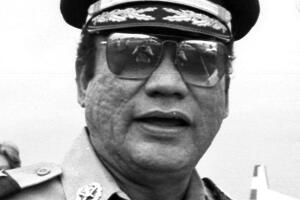
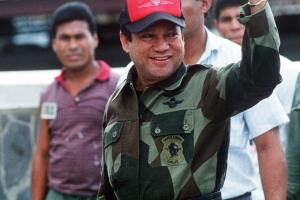
Manuel Antonio Noriega in 1985. Born in Panama City in 1934, he graduated from military school in Peru. Noriega became intelligence chief to Gen Omar Torrijos who seized power in a coup in 1968. Noriega secretly collaborated with the CIA, which was gathering intelligence on the spread of communism in Latin America.
Efe
Manuek Antonio Noriega 1988
Manuel Antonio Noriega in 1988. The lack of democracy in Panama under Noriega's military rule became a major issue as the US prepared tio turn over control of the Panama Cnala in the late 198os. Noriega was accused of electoral fraud, corruption and drug trafficking. The country fell into a deep economic recession and demonstrations against the government were brutally repressed.
CARLOS SCHIEBECK/Getty Images
Manuel Antonio noriega 1999
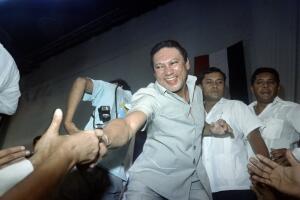
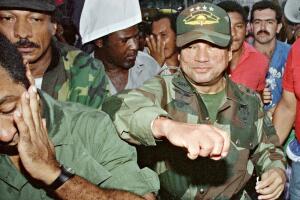
Panama City, Panama - Noriega greets supporters in May 1989, days before elections. Denouncing a fraud, supporters of the opposition candidate, Guillermo Endara protested in the streets. Noriega annuled the elections for "foreign interference."
MANOOCHER DEGATHI/Getty Images)
Manuel Antonio Noriega 1989
On October 3, 1989, rebel forces attempted to give a military coup to the Noriega government. Those responsible for the attempt were killed. The National Assembly of Panama formally designated to Noriega Head of Government and this declared the country is state of War against the USA. In the photograph, General Noriega leaves his headquarters in the city of Panama after the failed coup against him.
BOB SULLIVAN/AFP/Getty Images
Invasión Panamá, 20 de diciembre, 1989
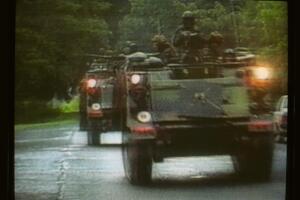
Dawn December 20, 1989 the US military launched an invasion of Panama. President George H. W. Bush announced that the US military was seeking to detain Noriega and protect "US interests" in the country.
Getty Images
Invasión Panamá 23 de diciembre 1989
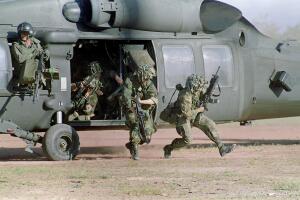
Santiago, Panama: U.S. soldiers run for cover following their landing in December 1989 in Panama. The military operation, codenamed 'Just Cause', involved 26,000 US troops and lasted two weeks. At least 400 Panamanian civilians and military were killed, and 23 US military. The invasion was condemned by the UN and the OAS. (MANOOCHER DEGHATI/AFP/Getty Images)
MANOOCHER DEGHATI/Getty Images
Invasión Panamá
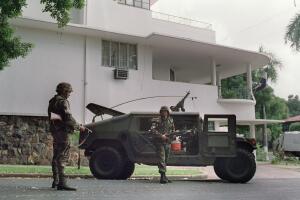
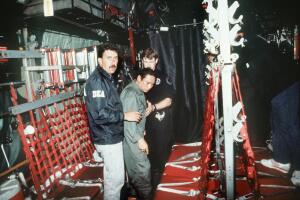
General Noriega took refuge on Christmas Eve in the Papal Nunciature, where he surrendered 10 days later on Jan 3 to US authorities. US forces surrounded the residence for three days and nights bombarded it with rock music. In the photograph, American soldiers in front of the Nunciature, where Noriega hoped to obtain asylum. (JONATHAN UTZ/AFP/Getty Images)
ONATHAN UTZ/AFP/Getty Images
Captura Noriega, 3 de enero 1990.
Howard Air Force, Panama: On January 3, 1990 General Noriega surrended to US forces and was turned over to the DEA before boarding a US military plane to face drug charges in Miami. (Photo STF/AFP/Getty Images)
Getty Images
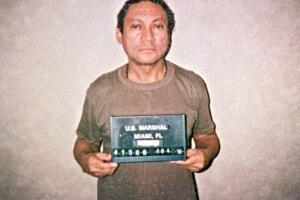
Noriega capturado en Miami, 4 enero de 1990.
In April 1992 Noriega was convicted in a Miami trial on eight charges of drug trafficking and money laundering.
Efe
Manuel Antonio Noriega, Paris. 2010
En abril de 2010 el gobierno de Estados Unidos aprobó la extradición de Noriega a Francia, donde cumpliría otros 10 años de condena por delitos de lavado de dinero. La fotografía es del día de su llegada a París y es llevado a una corte, el 27 de abril de 2010.
THOMAS COEX/AFP/Getty Images)
Manuel Antonio Noriega 2011
A year later in 2011 Noriega was sent back to Panama where he faced 60 years in jail for a prior conviction - in absence - for corruption, as well as the murder of opposition leader Hugo Spadafora and the assassination of former army officers, In the phonto he arrives, aged 77, at Renacer jail, December 11, 2011.
RODRIGO ARANGUA/AFP/Getty Images
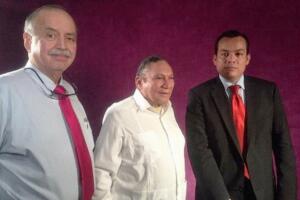
Manuel Antonio Noriega 2015
On June 24, 2015, Noriega publicly asked for forgiveness from jail. "I apologize to any person who feels offended, affected, harmed or humiliated by my actions or those of my superiors in fulfilling orders or those of my subordinates during the time of my civilian government and military."
Guillermo Cochez/Wikicommons
Manuel Antonio Noriega, 28 de enero 2017.
On January 28, 2017, Noriega is taken to an apartment owned by his daughter, under a temporary house arrest granted for his state of health, before being operated for a brain tumor. The surgery on March 7 left him in critical condition. He died May 30.