A prominent Honduran congressman with close ties to President Juan Orlando Hernandez, was sanctioned on Friday by the Trump administration for “involvement in significant corruption” related to drug trafficking.
U.S. Secretary of State, Mike Pompeo, named Oscar Ramon Najera, 69, and his son Oscar Roberto Najera as having ties to the Los Cachiros drug trafficking organization, adding that they, and their immediate family members, were no longer eligible for entry into the United States.
“Today’s action sends a strong signal that the United States stands with Honduras in its fight against corruption,” Pompeo said in a statement.
The sanctions against Najera and his son are the latest in a series of political embarrassments for the ruling National Party in Honduras, and comes only two months after the New York conviction of the president’s brother, former congressman Juan Antonio ‘Tony’ Hernandez, on drug trafficking charges.
Tony Hernandez is due to be sentenced on January 17. President Hernández, whom prosecutors identified as an unindicted co-conspirator in the case of his brother, has rejected the accusations against him, describing them as a fairy tale, comparable to 'Alice in Wonderland'.
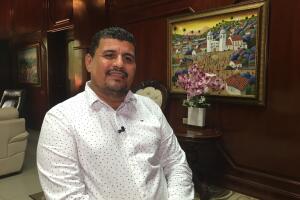
"This means nothing," Najera responded in a Honduran television appearance. "Personally, it doesn't bother me because I have always stuck to the right path in my personal life," he added.
Najera’s name has long been linked to corruption in Honduras and has also been mentioned in several recent drug trafficking cases. Devis Rivera, one of the leaders of Los Cachiros, testified in the October trial of Tony Hernandez that Najera gave protection to their drug shipments “with information of government investigations” and military and police checkpoints. “Oscar Najera would move them. When we needed him to -- move them away when we needed to go through the checkpoints, he would have them removed, sir. Whenever I asked him to,” Rivera told the court.
In his closing argument, prosecutor Emil Bove described Najera as “a close friend” of Tony Hernandez “who was a part of setting all of this up so that the Honduran government could be used to protects drug traffickers.”
When Hernandez was arrested at Miami International Airport in November 2018, he had Najera's contact information in his phone. Photos found on the phone also showed Najera in a hot tub with Hernandez. Another photo showed Najera with Juan Orlando Hernandez.
According to legal documents obtained by Univision, Los Cachiros supported Najera “with money, cattle, cars, helicopter rental for use in campaign” valued at approximately $1 million. In a document outlining evidence he would offer the U.S. government in return for his cooperation, Rivera told prosecutors that Najera promised to use his influence with Hernandez to “help stop extradition to US” of accused traffickers.
The Trump administration continues to work closely with the Honduran government on a variety of issues, from migration to drug interdiction.
President Trump acknowledged the role of president Hernández in combating drug trafficking in a speech in Miami last week. During the National Summit of the American Israeli Council, Trump said that "we are delighted to have with us President Juan Orlando Hernández of Honduras and the First Lady of Honduras. And I have to tell you, thank you sir, that President Hernández is working with the United States very closely ... and we're winning after years and years of losing. We're stopping drugs at a level that has never happened. "
Honduras
Gracias Lempira (ENG).JPG
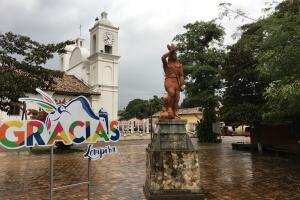
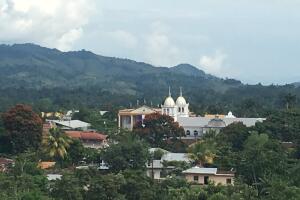
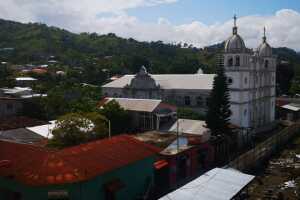
The central park of Gracias, Lempira, shows its indigenous history and the Spanish colonial era.
David Adams/Univision
PHOTOS/Daysi Iglesias1.JPG
Daysi Iglesias sells 'ticusos' a corn dough with beans as well as fruit juices, in the central square of Gracias, Honduras. "Yes, I know that the president's brother is in jail, but only they know what they've been up to. I've no idea. We just stick to our work."
PHOTOS/Domingo Gutierrez.jpg
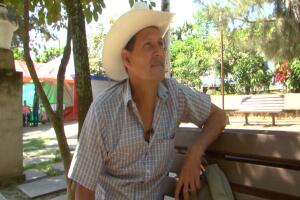
Gracias coffee grower, Domingo Gutierrez, 58, seated in the central square. Coffee prices have fallen and he struggles to make a living off his eight acres.
PHOTOS/Casa del presidente en Gracias.jpg
PHOTOS/Cubate house.jpg
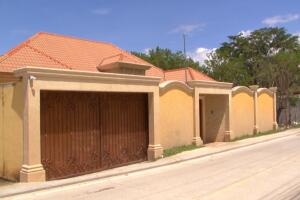
The house of former Gracias deputy mayor, Mario Jose Calix, who was indicted in January with New York and U.S. officials have requested the extradition of Calix, though his whereabouts are unknown. Univision visited his home in Gracias and spoke to his mother who said she hasn't seen her son son "in ages."
Marvin Valladares/Univision
PHOTOS/casa en construccion en Gracias.jpg
On the outskirts of Gracias, several modern, luxury residences are under construction that stand out in sharp contrast to the traditional, modest single-story homes in the town.
Marvin Valladares/Univision
Gracias municipality.png
The municipality of Gracias has 55,000 inhabitants, of which 22,000 live in the town and has an annual budget of approximately $ 2 million, according to the mayor.
Tony Hernandez and football.jpg
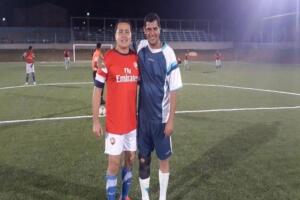
En Gracias, Tony Hernández es recordado como un típico ganadero que fue elegido para el congreso en 2013, así como un apasionado jugador de fútbol.
Municipio de Gracias, Lempira/Facebook
PHOTOS/Gracias airport.jpg
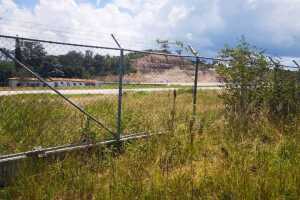
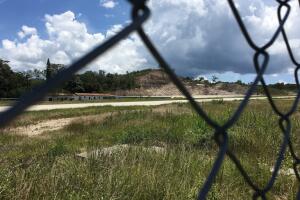
In April 2016 the government inaugurated a small, local airport on the outskirts of town as part of a national tourist plan to link major cities with the nearby famous ancient Mayan ruins of Copan. But the tourists never came.
David Adams/Univision
PHOTOS/Gracias airport2.JPG
The Gracias airport runway is now used almost exclusively by president Hernandez who visits at weekends. Residents also talk in hushed tones of suspicious planes landing in the dead of night bringing cocaine from Colombia, and the eastern Atlantic coast of Honduras.
David Adams/Univision
PHOTOS/Map of Honduras.jpg
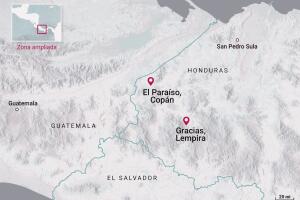
Western Honduras is a remote border area with Guatemala and El Salvador.
Mauricio Rodriguez-Pons/Univision
PHOTOS/El Paraiso.JPG
El Paraiso, Honduras, is nestled into the mountains of northwest Honduras just a few miles from the border with Guatemala. Draf traffickers took advantage of its strategic location to smuggle cocaine across the border.
David Adams/Univision
PHOTOS/El Paraiso municipality.jpg
Mayor Alexander Ardon built a splendid new municipal building with a portico with columns that became famous in the Honduran media. But local residents say he did good things for the town, providing basic services they didn't have before.
Claudia Mendoza/Univision
PHOTOS/El Paraiso iglesia.jpg
Even if some of the public works in El Paraiso may have been paid for with drug money, residents said they were grateful. When killings took place they were mostly between the drug traffickers. they added.
Claudia Mendoza/Univision
PHOTOS/El Paraiso streets.jpg
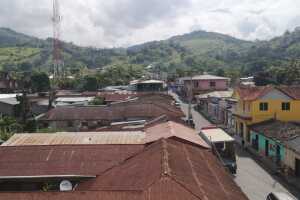
El Paraiso is a quiet town located in the province of Copan, in northwest Honduras. It became notorious in recent years as a haven for drug traffickers seeking to transport cocaine into Guatemala en route to the United States.
Cludia Mendoza/Univison
PHOTOS/El Paraiso iglesia y parque.jpg
Across from the El Paraiso town hall, a new park is being built wiht miunicpal funds, complete with a replica of a Mayan temple. The town in close to the famous Mayan ruins of Copan, one of the country's main tourist attractions.
Claudia Mendoza/Univision
PHOTOS/Adonias Morales.JPG
Adonias Morales, 53, mayor of El Paraíso in his office. His close friend and former mayor, Alexander Ardon, turned himself in to the DEA in February and is expected to testify against Tony Hernandez, brother of the Honduran president, who goes to trial in New York on October 2, accused of being "a violent multi-ton drug trafficker."
David Adams/Univision
Marvin.JPG
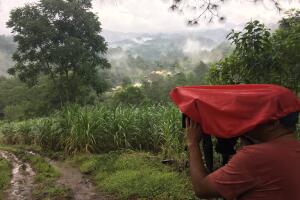
Univision cameraman, Marvin Valladares, captures images of hillsides cloaked in mist in western Honduras.
David Adams/Univision